Product Hunt · 2018–2019
Rebuilding Product Hunt's Taxonomy
How I redesigned Product Hunt's category system to rank for hundreds of new keywords and drive 10,000s of monthly organic visits.
TL;DR
Product Hunt's flat tag system didn't map to how people searched, and competitors ranked for “best [category] tools” while we ranked mostly for product names. I audited the topic system, analyzed search data, and designed a two-tier category hierarchy paired with programmatic SEO landing pages. To avoid launching with empty pages, I manually categorized 5,000+ products.
The new taxonomy enabled Product Hunt to rank for hundreds of new keywords, driving 10,000s of monthly organic visits. Over 6,000+ makers self-categorized their products within the first months after launch.
01 · The Problem
The Old System: A Taxonomy Disaster
Product Hunt's taxonomy was a flat Tumblr-style tag system—“iPhone App” alongside “Artificial Intelligence” alongside “Cats.” It didn't map to how people searched, and competitors ranked for “best [category] tools” while we ranked mostly for product names.
- 01No hierarchy: “Artificial Intelligence” sat next to “Cats” and “Drake” with equal importance
- 02Popularity bias: The UI showed topics sorted by # of products, making “iPhone App” dominate while niche but useful categories stayed buried
- 03No SEO value: Competitors ranked for “best [category] tools” while we only ranked for individual product names
- 04Inconsistent tagging: Makers chose whatever felt right—similar products ended up in completely different topics
02 · The Approach
Building the New Taxonomy
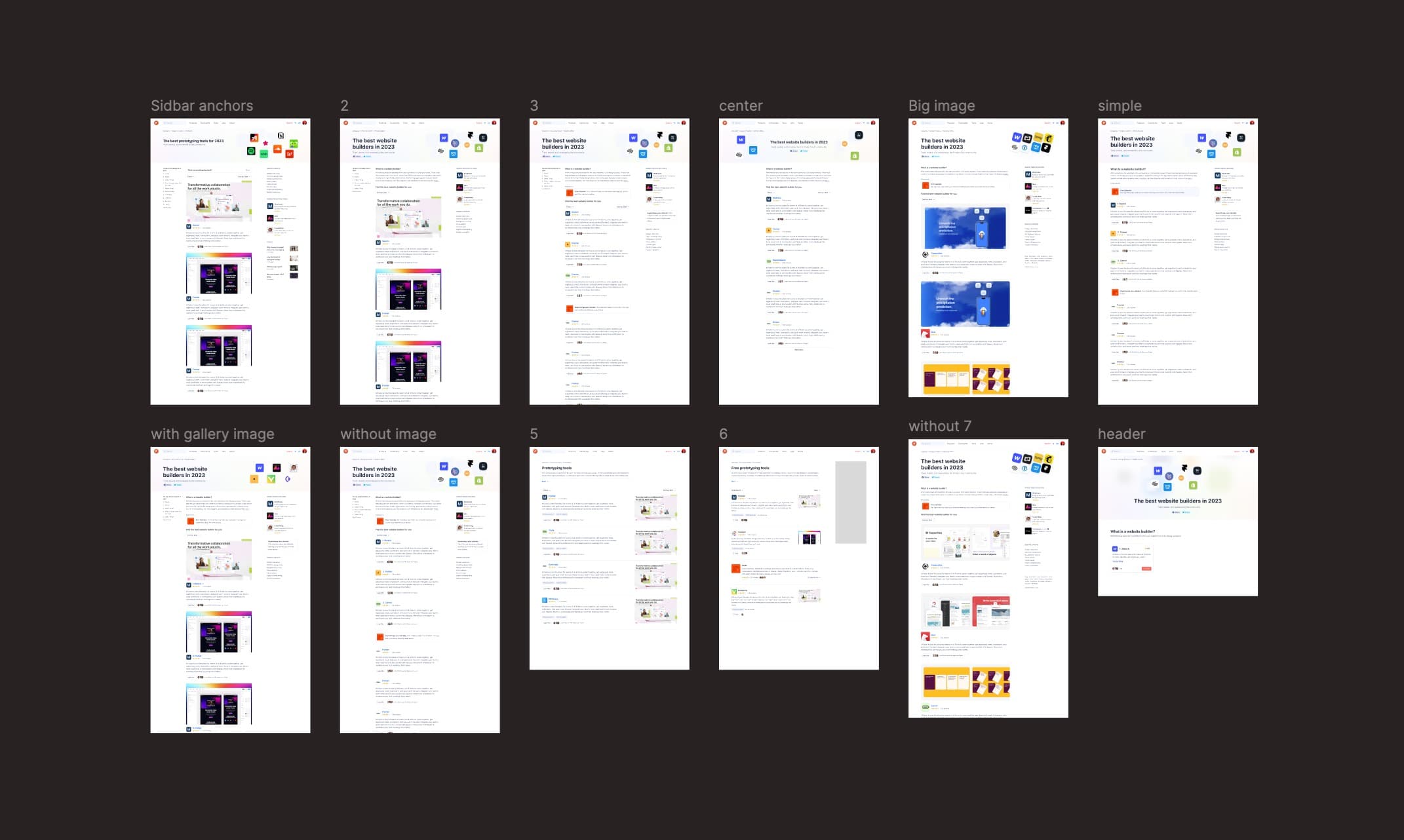
I audited the entire topic system and analyzed search data and competitor rankings to understand what users actually searched for. This revealed patterns around job functions (Marketing, Development), use cases (Productivity, Analytics), and platforms (Web App, macOS). I designed a two-tier category hierarchy to map to these search patterns and created guidelines for consistency.
Manual Categorization Process
Before launch, I manually categorized 5,000+ products to avoid empty states and establish quality standards:
- 01Exported top products by upvotes from each existing topic
- 02Created categorization guidelines (examples of what belongs where, edge case rules)
- 03Batch-categorized products using spreadsheets, noting patterns and ambiguous cases
- 04Reviewed with product team to validate taxonomy made sense across different lenses
03 · In Context
The New Category System
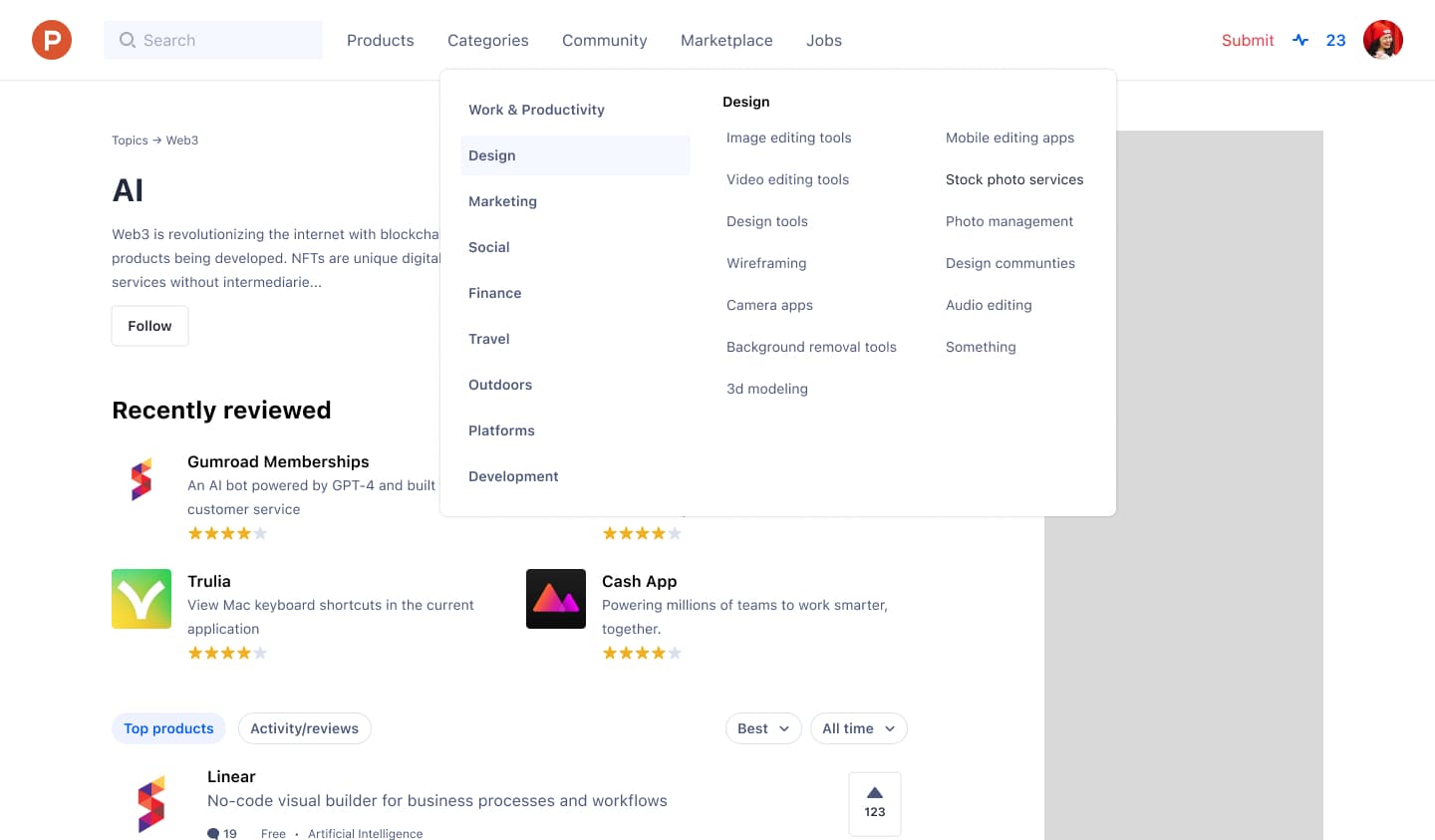
The final taxonomy organized products into 20 parent categories with 200+ subcategories, built around how users actually searched. Clean navigation made it easy to drill down from broad categories like “Developer Tools” to specific subcategories like “API Tools” or “Testing.”
SEO Landing Pages
Each category generated programmatic SEO pages targeting search queries like “best [category] tools” and “[category] products.” Pages included featured products, recent launches, and filtering—genuinely useful content, not SEO spam.

04 · Old vs New
System Comparison
| Old System | New System | |
|---|---|---|
| Structure | Flat list of 200+ tags | Two-tier hierarchy: 20 parent categories, 200+ subcategories |
| Discoverability | Sorted by popularity only | Organized by intent and searchability |
| SEO Impact | Minimal — only product names ranked | Thousands of indexed category pages |
| User Tagging | Free-form, inconsistent | Guided, curated options |
| Product Distribution | Varied wildly (1 to 10,000+ per tag) | Balanced distribution via manual curation |
05 · Reflection
Manually categorizing 5,000 products was tedious but necessary. We launched with no empty states, quality seed data for SEO, and built-in incentive for makers to categorize their own products to appear with competitors.
The old system had an unfortunate feedback loop: the Topics page sorted by popularity, which was being reinforced by the same sorting in our product creation UI. This created extremely general, not useful topics as the most used.